Cost Curves and Curve Balls
Published: September 24, 2018
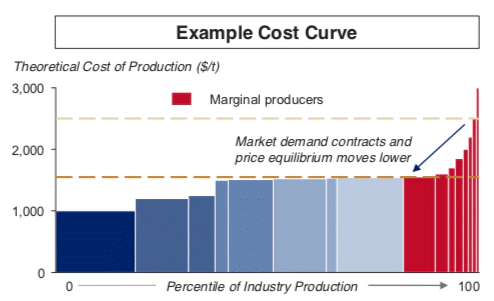
Cost curves are a staple of the mining industry, similar in shape to a traditional supply curve, ranking mines/smelters/mills by their total cost of production. The theory goes that when the demand curve shifts to the left, as it inevitably will with the business cycle, those with the highest costs will be first to close, re-establishing equilibrium at a lower price and quantity.
So far so good? Sort of.
In practice there are many reasons why an asset high on the cost curve, loss making on an operating basis, may keep the lights on. CFOs are loathe to take write-downs; running at a $50Mn loss and telling the market you are committed to the project and the strategy the Board approved is far more palatable than crystallising a $1Bn impairment. Debt needs to be serviced and care and maintenance costs aren’t cheap either.
And there is - quite rightly - an increased awareness of the social responsibility operators have within the local community. Large assets with workforces in the thousands and financing in the hundreds of millions leads to ‘sticky’ supply and prices which can eat deep into the cost curve.
This in turn has Executives berating their analysts - ‘how can prices be at the 40% percentile and have been here for months?’ What they fail to grasp is that constructing a cost curve requires data, so that they are backward looking by design. This makes them a good record of history, especially when it comes to measuring how much more cost a competitor was able to take out of an asset than you thought possible, but no good for price forecasting.
Nor are cost curves particularly useful at the other end of the spectrum. Supply in many commodities is highly inelastic due to the capex required to develop large projects, with lead times measured in years. This creates the self fulfilling prophecy during upswings in the commodity cycle whereby the demand curve does not intersect the cost curve for all but the smallest and most opportunistic producers, where the gradient is steepest and where demand itself is at its most elastic, thereby creating a high degree of uncertainty in price.
This is not a problem if your timeframe for analysis matches the metric - namely long term capital allocation between commodities and/or assets within a portfolio, M&A activity etc. But in the short term they’re a tool whose value decays quickly.
Throw in the involvement of CTAs, Index funds, HFTs and Chinese retail investors and it is no surprise that cost curves begin to look esoteric.
The increased sophistication of the digital age instead requires a new set of tools - software that is able to process multiple, disparate data sets, providing risk aware, distributed forecasts.
With these you can make informed market decisions, supply products that your customers value above your competitors, thereby enabling you to deepen relationships by moving towards a servicisation model.
The future ain’t what it used to be. RIP Yogi