Should you care about dividends – mining and progressive dividends?
Published: February 29, 2016
This generous dividend policy had been backed by extremely strong commitments from management. Andrew Mackenzie, CEO of BHP Billiton, said in August last year “You shouldn’t doubt our commitment to maintain the progressive dividend…Over my dead body sounds a little strong but it’s almost right”. In December 2015, Sam Walsh, CEO of Rio Tinto, said “Dividends are very high on our radar screen. Personally, for me, they are very, very important. We have shareholders who are invested in our business. They put their faith in us and I believe they need a fair return. At the end of the day, it’s a board decision, it’s not my decision.”
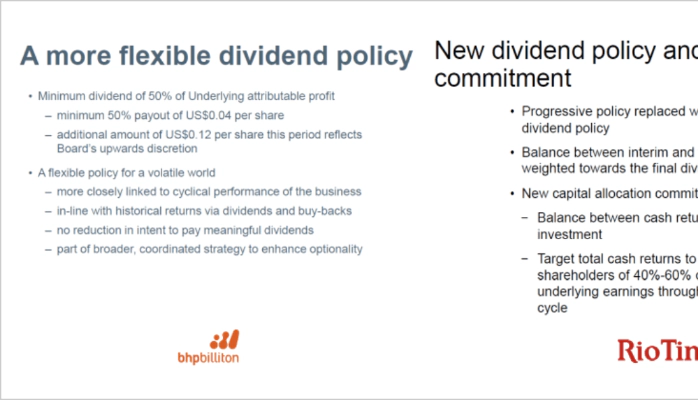
Then suddenly everything changed. Rio announced on 11 February “… the board believes that maintaining the current progressive dividend policy would constrain the business and act against shareholders’ long-term interests. We are therefore replacing the progressive dividend policy with a more flexible approach that will allow the distribution of returns to reflect better the company’s position and outlook.”
BHP announced on 23 February its revised dividend policy which would be “more closely linked to cyclical performance of the business” which contrasts with the statement still posted on their website stating “BHP Billiton has a progressive dividend policy. The aim of the policy is to steadily increase or at least maintain the dividend per share in US dollar terms at each financial half year.”
The shift from a progressive dividend policy by the majors has prompted a few questions at Mine Insider:
- Specifically, how should investors react to this dramatic change in policy?
- More generally, should commodity producers, such as mining companies, commit to progressive dividend distributions in the first place? And,
- Most importantly, if a mining company commits to progressive dividend payouts, does that increase the value of this specific company for some or all of its investors?
Firstly, we think shareholders – especially those who bought shares in recent months because they were attracted to the dividend yield – should be asking some hard questions of the companies. Precisely when did it become apparent to the companies that they could not afford the ever increasing dividends? Questions were being asked about the sustainability of the policy in 2014. If the companies were reviewing their dividend policy prior to the decision (which seems more than likely in view of the public debate in the last year or so), it is a question for the FTSE/ASX and the regulators to decide if continuous disclosure requirements were complied with, particularly in view of the strong statements by directors in the last few months.
At Mine Insider, we think progressive dividend policies are fundamentally incompatible with a cyclical industry such as mining. If mining companies do not undertake to manage their supply to match markets and treat price as an externality (a whole debate in its own right), then continually increasing dividends does not make logical sense. Worse still are companies borrowing money to maintain dividend levels when mineral prices fall. This looks and smells like a Ponzi scheme. So we are skeptical of management and Boards of mining companies that commit to progressive dividends and our bet is always that the volatility of mineral prices will trump hollow promises.
But do dividends matter? Essentially, we don’t think so. In 1958, two legendary economists, Franco Modigliani and Merton Miller, proposed the irrelevance of dividends – and went on to win Nobel prizes as a result. We at the Mine Insider strongly disagree with the proposition that investor value is enhanced just because a Board commits to any particular dividend policy, let alone a commitment to patently unsustainable progressive dividends.
Warren Buffett’s Berkshire Hathaway seems to have done OK without dividends. Google/Alphabet got to be the largest company in the world without dividends and Apple’s dividend policy is famously miserly. At the Mine Insider, we believe cashflow is the ultimate determinant of shareholder value. In the case of mining companies producing and selling minerals with variable prices then cashflo
ws will also be variable and a flexible dividend policy makes sense.
So what are our takeaways from all of the posturing and signaling over dividends:
- Unfortunately, the strongest signal is that the major mining companies are essentially skint, suggesting limited capital discipline and ineffective balance sheet management. At the end of the best decade for commodity prices in history, the companies have neither accumulated cash reserves nor paid out much of the cashflows. Apple has $216 billion of accumulated cash and on our calculations the four major mining companies should be sitting on $400 billion (see our post ‘$400 billion reasons mining management must change’). We now know that the piggy bank is empty as the major companies have significant net debt and ratings are being downgraded.
- Are the companies managing change or just reacting? Tim Schroeders of Pengana Capital gave the Age an apt quote ’More and more it could appear to investors that the [BHP Billiton] Board is lagging in its response to current circumstances and the dividend just underscores that.’
- Given the particularly strong supporting statements by CEOs in recent months, we can only assume that the individuals were rolled by their Boards. If the Boards of these companies don’t support the CEOs, then shareholders need to be especially careful as this plays out.